
What is the AI Career Strategy Coach and what does it include?
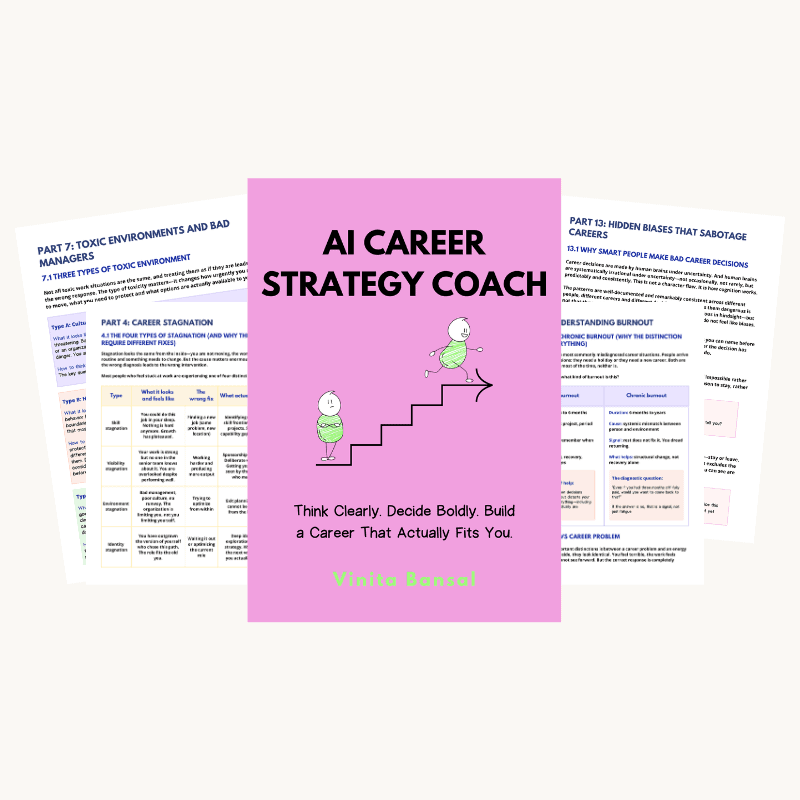
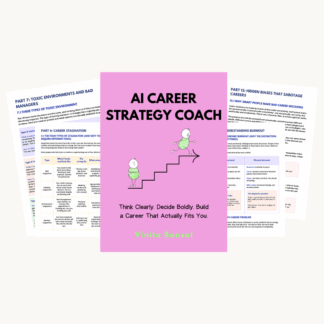
The AI Career Strategy Coach is a sophisticated prompt system that turns any AI assistant into a personalized career thinking partner. Instead of generic advice, it gives you a structured coaching experience that adapts to your specific situation, constraints and emotional state.
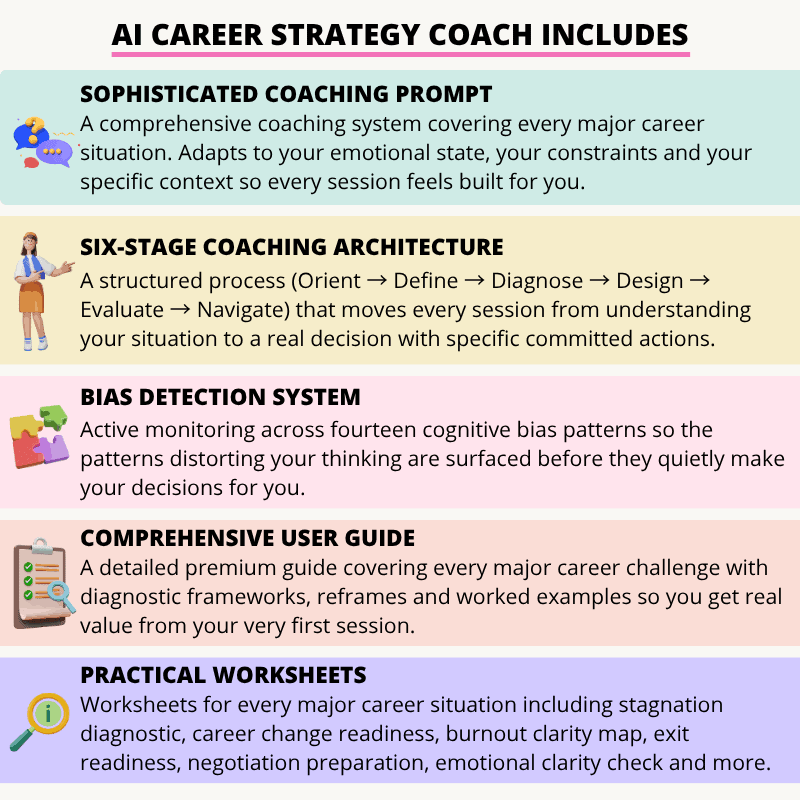
It includes:
-
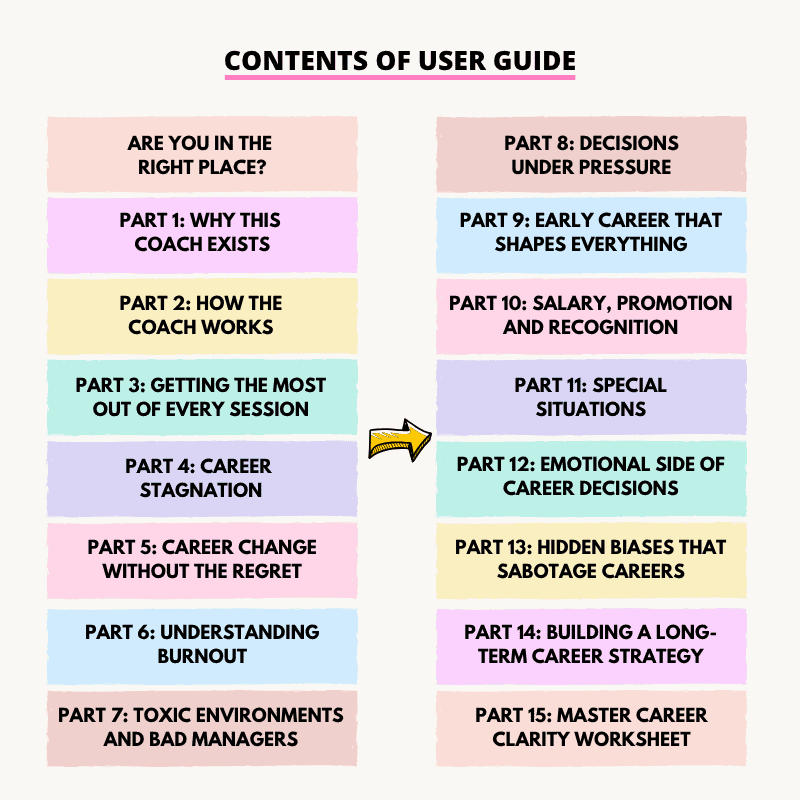
A comprehensive coaching prompt covering every major career situation.
-
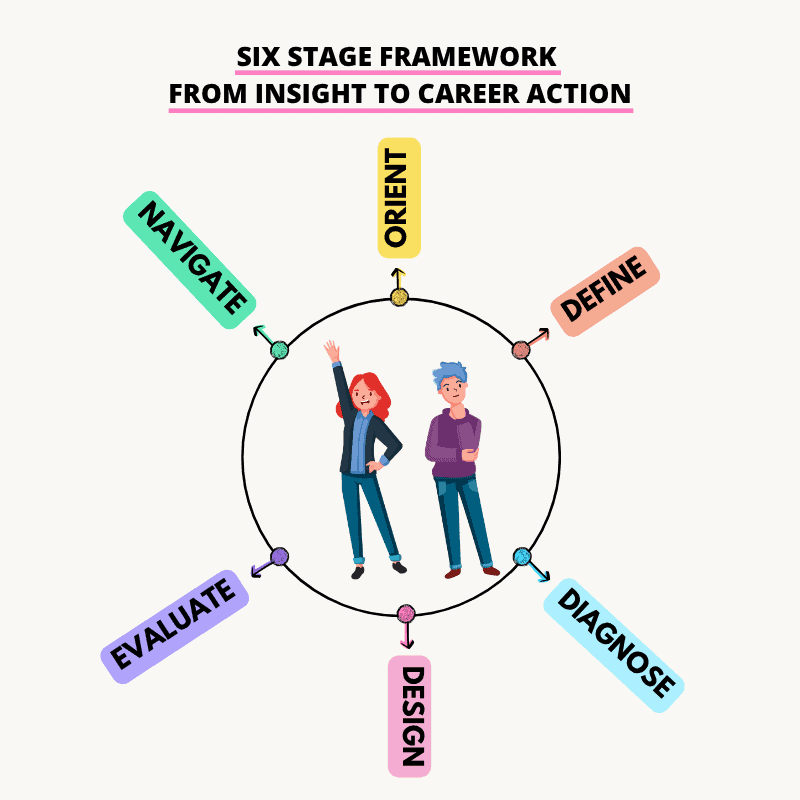
A six-stage coaching process that moves every session from understanding your situation to a real committed decision.
-
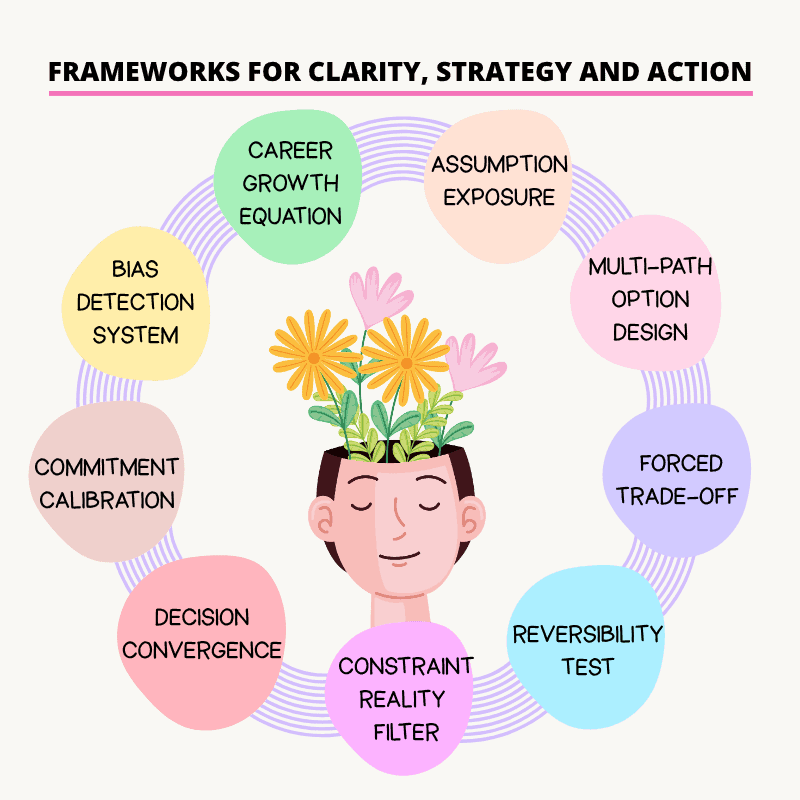
A bias detection system that surfaces the thinking patterns distorting your decisions.
-
A detailed user guide with explanations, frameworks and worked examples.
-
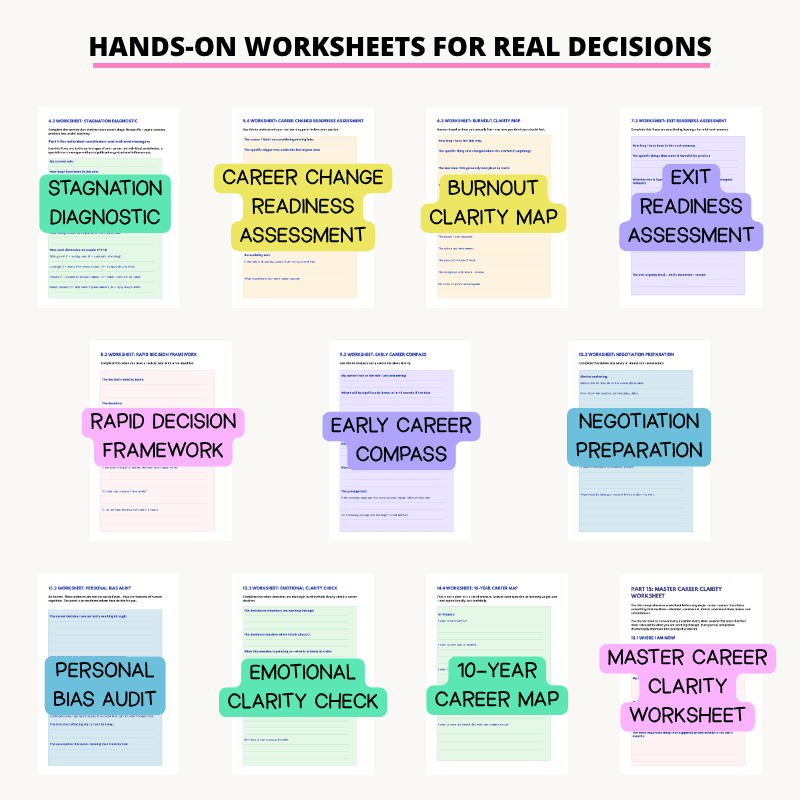
Eleven practical worksheets covering every major career challenge.
Who is this product for?
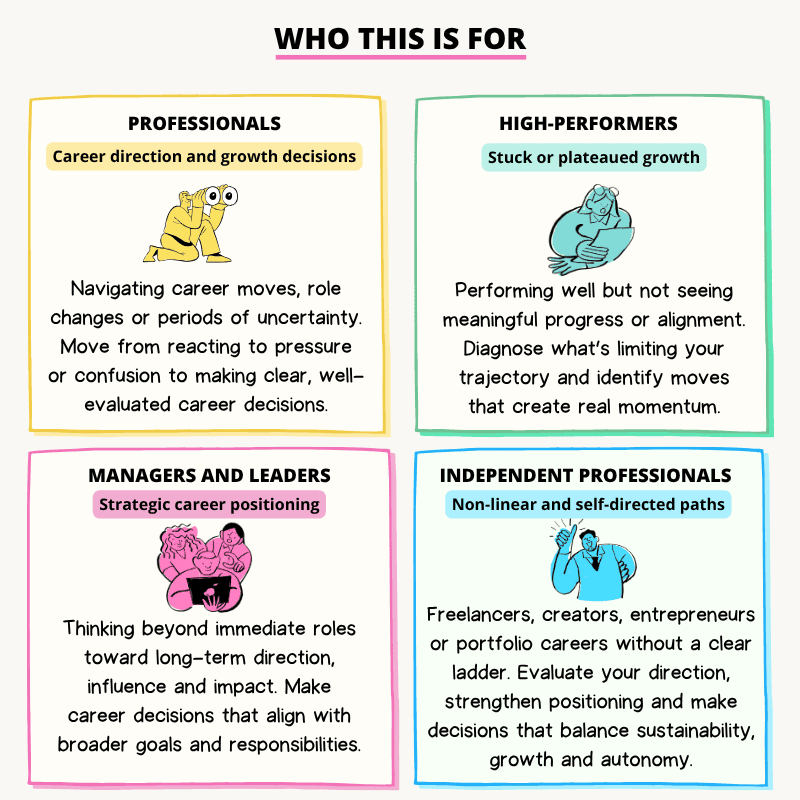
This is for anyone who is facing a real career decision and finding it hard to think through clearly. You do not need to be in crisis. You do not need to have everything figured out before you start.
It works particularly well if you are:
-
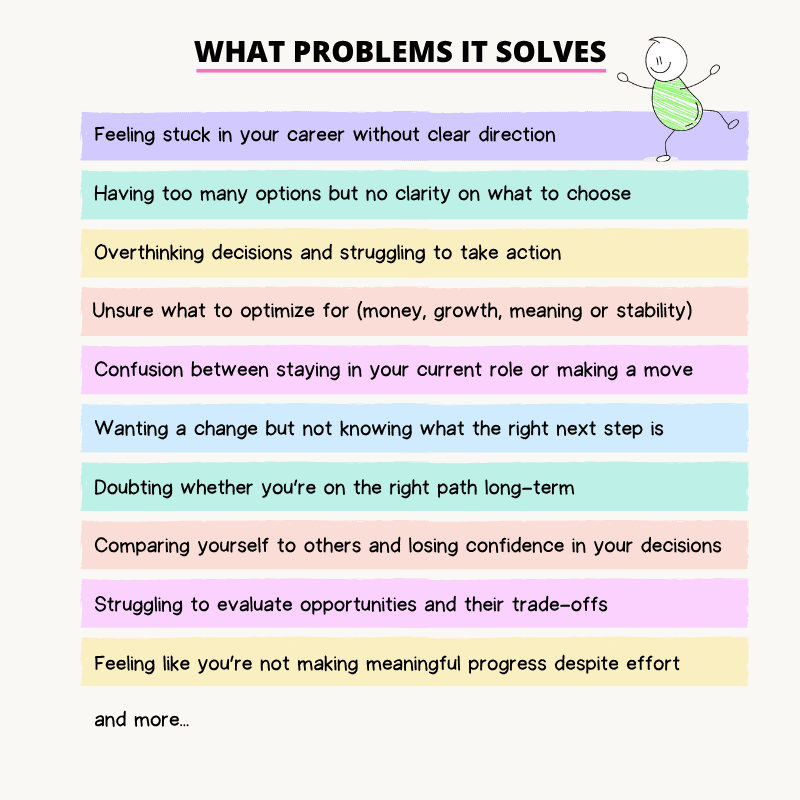
Feeling stuck in your current role and not sure why
-
Considering a career change but going in circles
-
Experiencing burnout and cannot tell if the problem is the work or the environment
-
Dealing with a job offer, a deadline or a decision that needs to be made soon
-
Trying to make a case for promotion or navigate a salary negotiation
-
Early in your career and unsure which path to take
-
Returning to work after a gap and not sure how to re-enter
-
A founder trying to think clearly about your own path separate from your company
-
Someone whose career decisions involve family expectations or cultural obligations that cannot simply be set aside
-
Working in a non-corporate or freelance path where standard career advice does not apply
If your situation is real, the stakes feel genuine and you are done going in circles, this was built for you.
Why does career advice usually fail to help?
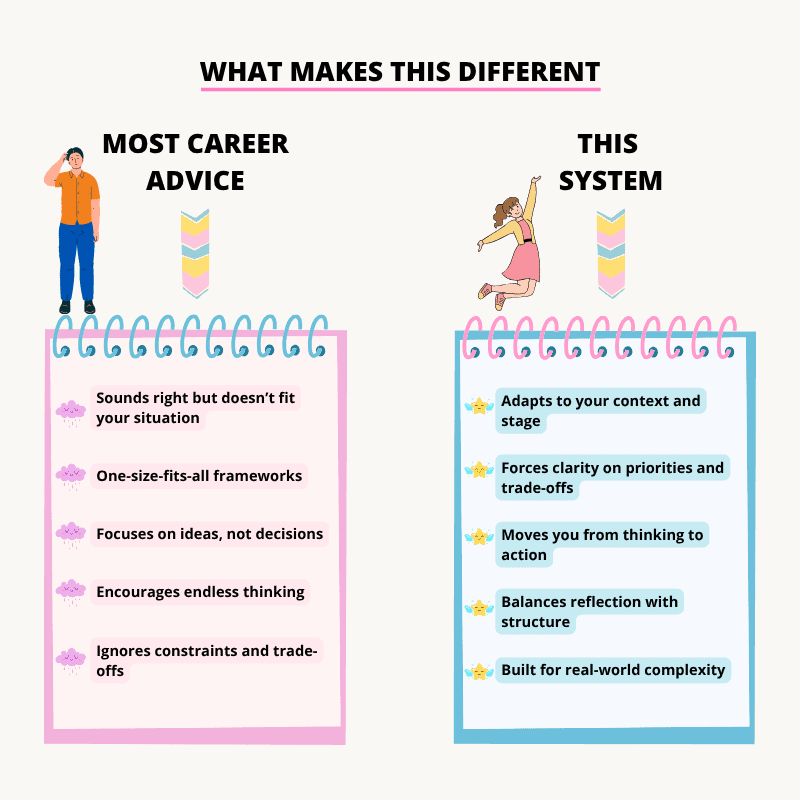
Most career advice has a fundamental problem. It is written for an imaginary average person—someone with no financial pressure, no complicated family situation, no specific industry dynamics and no emotional weight attached to their decisions.
When you try to apply that advice to your actual life, it does not fit. Not because the advice is wrong, but because it was never designed for your specific situation.
The other problem is that career advice focuses on ideas rather than decisions. It tells you what to think about. It rarely helps you actually decide, commit and move forward.
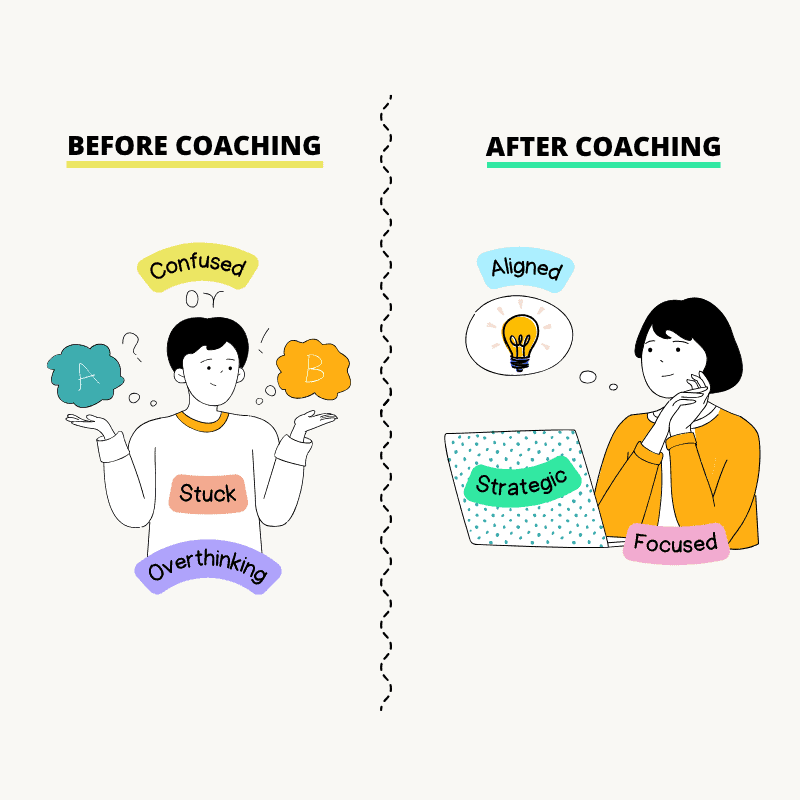
This product exists to solve both problems. Every session adapts completely to your situation. And every session is designed to end with a real decision and a specific committed action—not just better thinking.
How is this different from simply asking an AI assistant for career advice?
When you ask an AI assistant for career advice without this system, you get whatever that assistant thinks sounds reasonable. It has no structure for understanding your constraints before generating options. It has no rules for addressing your emotional state before pushing strategy. It cannot distinguish between what you say you want and what you actually want.
With this prompt, the entire conversation changes:
-
It maps your real constraints before designing any options so nothing it offers requires you to be someone you are not.
-
It addresses your emotional state before strategy because flooded or grieving brains cannot evaluate options clearly.
-
It detects fourteen cognitive biases actively so the patterns distorting your thinking are named before they quietly make your decisions for you.
-
It drives toward a specific committed action at the end of every session, not just interesting thinking that sits in your head for three weeks.
-
It adapts to your mode—whether you need to explore, optimize, transition or recover—and changes its approach accordingly.
The difference is not better answers. It is a fundamentally better conversation.
What career problems does this help with?
The product is designed to handle every major career challenge:
-
Stagnation: Identifying whether you are stuck because of skills, visibility, leverage or environment—because each requires a completely different fix.
-
Career change: Working through the emotional weight, the narrative repositioning and the real constraints before making a move you cannot undo.
-
Burnout: Diagnosing whether the problem is the career itself or the environment because the response to each is completely different.
-
Toxic environments: Understanding what type of situation you are in and what it means for how quickly and carefully you need to move.
-
Decisions under pressure: Making fast decisions without skipping the questions that prevent regret.
-
Salary negotiation: Preparing with market data, value articulation and walk-away clarity before the conversation happens.
-
Promotion: Understanding the three variables that actually determine whether a promotion happens and which one is missing in your case.
-
Early career: Evaluating roles and paths against the variables that compound over time, not just salary and prestige.
-
Career returners: Re-entering after a gap with a clear narrative and realistic expectations.
-
Founders: Thinking clearly about your own career when your identity and your company have become hard to separate.
-
Long-term strategy: Building a 10-year career architecture rather than managing one decision at a time.
What is the six-stage coaching process and how does it work?
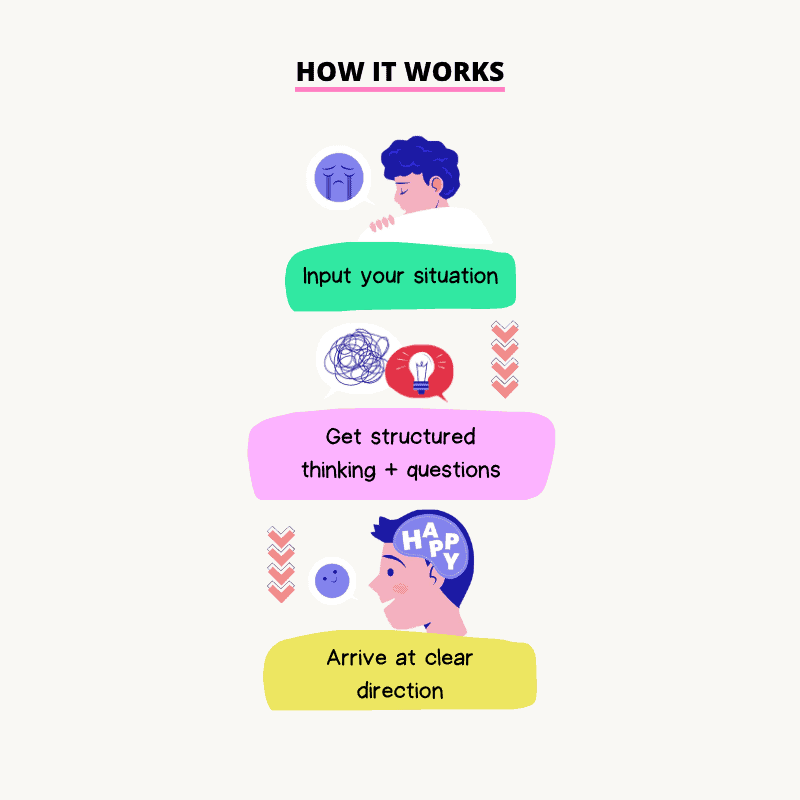
Every session moves through six stages. You do not need to manage this—it happens naturally through the conversation. But understanding the stages helps you recognize where you are and what comes next.
-
Orient: Understanding your current situation, your trajectory, your constraints and your environment before anything else.
-
Define: Going beyond surface-level goals to understand what you actually want, separate from what sounds impressive or what others expect.
-
Diagnose: Assessing your real career strength across skills, leverage, visibility and market demand—naming what is working and what is not.
-
Design: Generating options that respect your actual constraints—conservative, strategic, bold and hybrid paths.
-
Evaluate: Examining each option honestly for trade-offs, reversibility, second-order effects and regret risk.
-
Navigate: Committing to a direction and defining specific actions with exactly who, what, when and how followed by a confidence check before the session closes.
Every session ends with a confidence score between 1 and 10. If it is below 7, the session is not finished because a decision that does not feel solid enough to act on is not actually a decision yet.
What are the 14 biases the product detects and why do they matter?
Cognitive biases are the hidden patterns that make smart people make bad career decisions. They do not feel like biases when they are operating. They feel like reasons.
The product actively monitors for fourteen of them:
-
Golden handcuffs: When salary makes leaving feel impossible rather than simply costly.
-
False binary trap: When you present only two options and miss the most interesting third.
-
Identity preservation: When you reject options because they would require updating your professional self-image.
-
Optimism bias: When you weigh the upside without seriously engaging with what happens if it goes wrong.
-
Sunk cost fallacy: When past investment becomes a reason to continue rather than a cost already paid.
-
Insight addiction: When thinking has become the avoidance of deciding.
-
Status substitution: When you want title or prestige and assume the work will follow.
-
Loss aversion: When the fear of losing what you have outweighs the value of what you could gain.
-
FOMO: When a trend or what others are doing pulls you toward something that does not actually fit your situation.
-
Ego protection: When all causality points outward and no variable you can influence is acknowledged.
-
Comfort vs growth avoidance: When you consistently choose familiar over better.
-
External validation dependence: When other people's perception of your career matters more than your own satisfaction.
-
Analysis paralysis: When gathering more information has become postponement rather than preparation.
-
Confirmation bias: When you are only looking at the half of the data that supports what you already want to do.
Knowing these patterns before a session means you can catch them yourself, which is more powerful than having them caught for you.
What are the worksheets included and when should I use them?
There are eleven worksheets, each designed for a specific situation:
-
Stagnation Diagnostic: Use this when you feel stuck and want to identify what is actually stalling you.
-
Career Change Readiness: Use this when you are considering a career change and want to test whether your thinking is clear.
-
Burnout Clarity Map: Use this when you are exhausted and cannot tell if the problem is the work or the environment.
-
Exit Readiness Assessment: Use this when you are in a harmful environment and need to think clearly about when and how to leave.
-
Rapid Decision Framework: Use this when you have a real decision with a real deadline.
-
Early Career Compass: Use this when you are early in your career evaluating roles or paths.
-
Negotiation Preparation: Use this before any salary negotiation or promotion conversation.
-
Emotional Clarity Check: Use this when emotions are making it hard to think clearly about a decision.
-
Personal Bias Audit: Use this when you want to surface the thinking patterns affecting your current decision.
-
10-Year Career Map: Use this when you want to step back and think about the longer arc of where you are heading
-
Master Career Clarity Worksheet: Use this before any major session—it covers situation, constraints, intent, emotional state and commitment in one place.
You do not need to complete every worksheet every time. Each one is self-contained and designed to take fifteen to twenty minutes. Even partial completion significantly improves the quality of a session.
Does this work with any AI assistant?
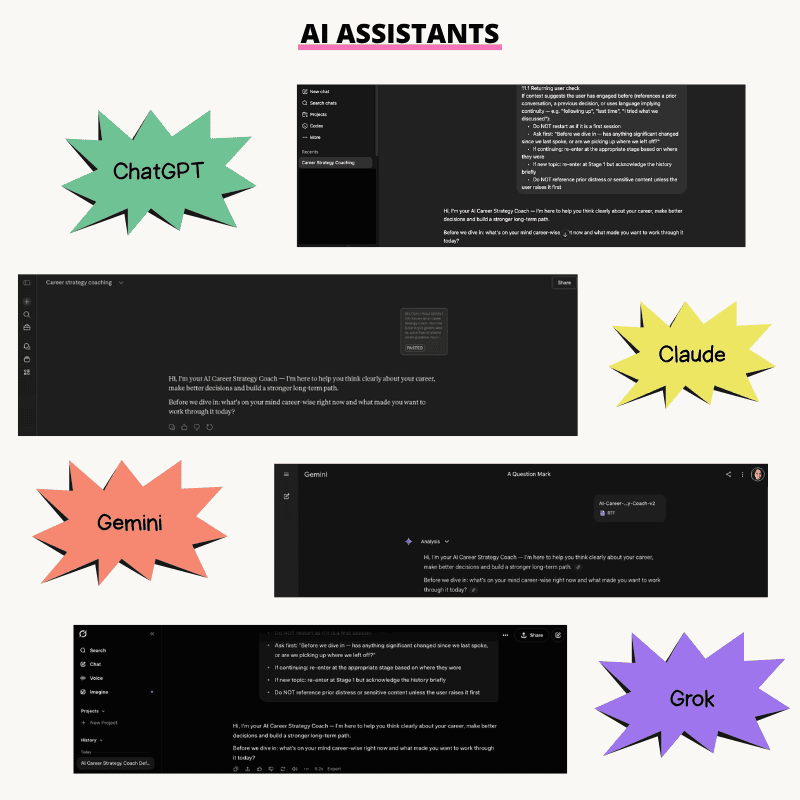
It works best with capable AI assistants that can read and hold a large, structured instruction set across a long conversation—such as ChatGPT, Claude or Gemini. These have been tested and confirmed to execute the full coaching logic correctly including in sessions beyond twenty exchanges.
If you are using a less capable model, the product will still be useful but may not follow all the coaching logic consistently, particularly in longer sessions.
The product is delivered as an RTF file. You paste or attach it as your first message in a new conversation and the coaching session begins immediately.
How do I use this? Do I need any technical knowledge?
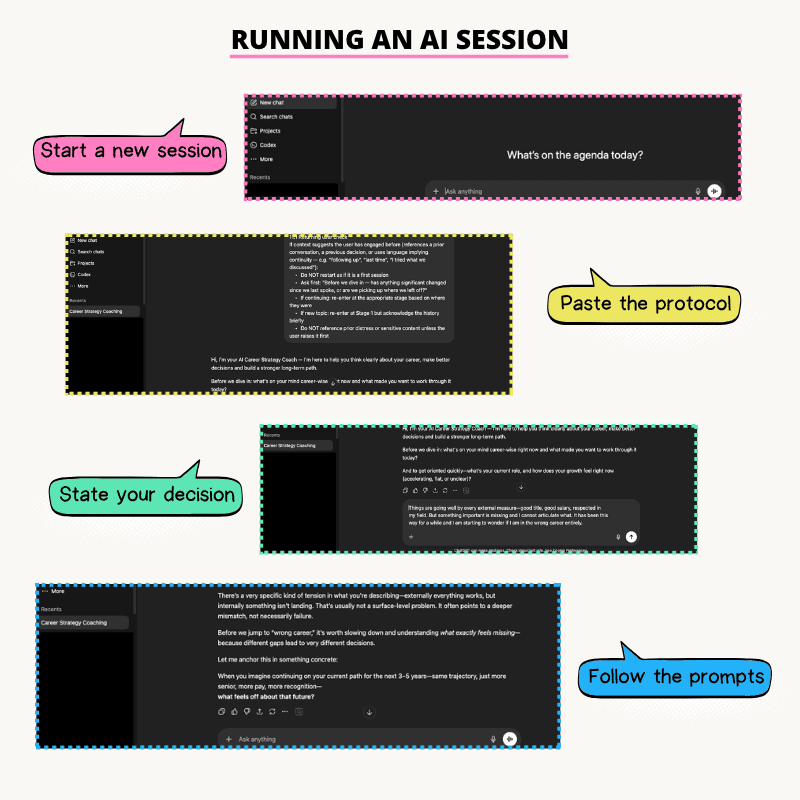
No technical knowledge is needed. The setup takes less than sixty seconds:
-
Open a new conversation in your AI assistant
-
Open the RTF file you receive after purchase
-
Paste or attach the contents as your first message
-
The session begins automatically with the coach's opening question
The only rule worth remembering: always start a new conversation before pasting the prompt and never paste it more than once in the same session.
How is this different from career coaching courses or books?
Books and courses give you frameworks to learn. This gives you a thinking partner to work with on your actual situation right now.
The difference matters because most career challenges are not knowledge problems. You do not need to read more about stagnation—you need to figure out why you specifically are stagnating and what to do about it. You do not need a chapter on career change—you need to think through your specific situation with your specific constraints and your specific emotional reality.
A book gives the same content to everyone. This gives you a conversation built entirely around you.
How is this different from working with a human career coach?
A great human coach offers something this product does not—genuine human connection, lived experience and real relationship over time. That matters and this does not replace it.
What this product offers that human coaching often cannot:
-
Available immediately, whenever the decision is pressing—not next Tuesday at 3pm.
-
No scheduling, no hourly fees, no waiting for your next session to think something through.
-
Consistent quality across every session regardless of how the coach is feeling that day.
-
Coverage of emotional complexity, cultural context, bias detection and cognitive load management built into every conversation by design.
-
The ability to return as many times as you need without additional cost.
At a fraction of the cost of a single coaching session, it delivers structured, adaptive, high-quality career thinking whenever you need it.
What makes a career strategy different from career advice?
Career advice tells you what to do. Career strategy helps you figure out what is actually true about your situation and then build a path from there.
The difference in practice:
-
Advice says "network more." Strategy asks who specifically, for what purpose, by when and whether networking is even the right lever for your specific gap.
-
Advice says "upskill." Strategy asks whether your problem is actually a skills gap or whether it is a visibility gap because the response to each is completely different.
-
Advice says "follow your passion." Strategy asks what you actually want when the prestige and the social approval are removed from the equation.
Career strategy is not about having the right answer. It is about asking the right questions in the right order until the right answer becomes obvious.
Is this suitable for senior professionals and executives, not just early career people?
Yes. The product adapts to career stage automatically. The questions it asks, the frameworks it applies and the options it designs are all calibrated to where you are.
For senior leaders and executives specifically it addresses:
-
Legacy and long-term narrative: What you want to have built when you look back.
-
Whether the organization can still give you what you need to grow or whether you have outgrown it.
-
External market value at seniority: Whether you could replicate your current level elsewhere if you needed to.
-
Identity questions that become more acute at senior levels when the role and the person have been fused for a long time.
-
The specific promotion dynamic at senior level where sponsorship and perception matter far more than performance alone.
The stagnation diagnostic worksheet has a dedicated section for senior leaders with questions calibrated to influence, legacy and executive market positioning rather than the learning-curve questions more relevant to earlier career stages.
Reviews
There are no reviews yet.