
What is a decision making framework and why is it important?
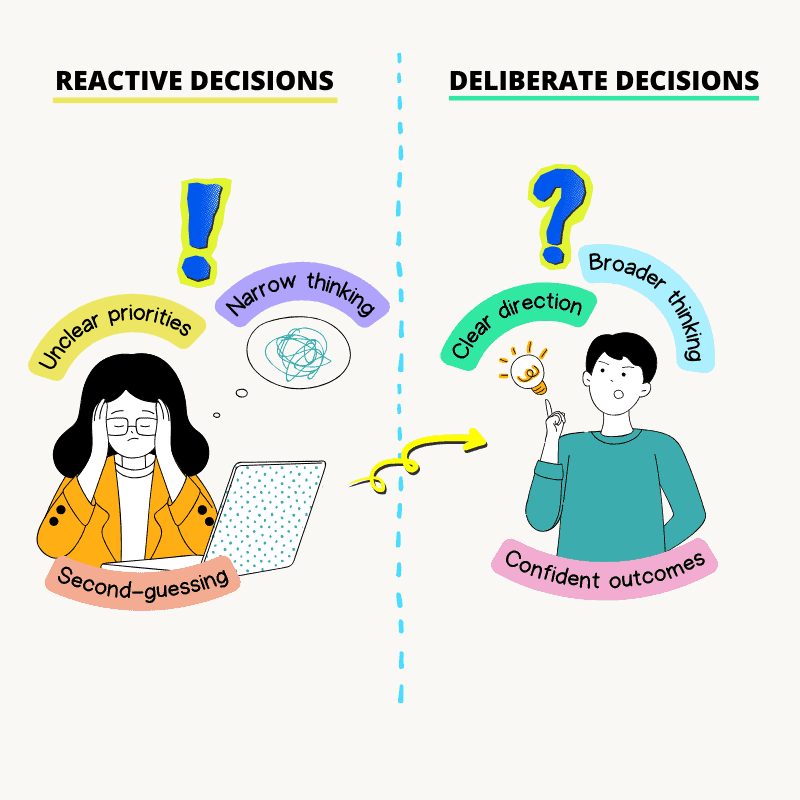
A decision making framework is a structured approach that helps you evaluate options, risks and trade-offs before making a choice. Instead of reacting to a situation, it forces you to think through it systematically.
Without a framework, decisions are often influenced by:
-
Emotional reactions (frustration, fear, urgency)
-
Incomplete information
-
Narrow thinking (only considering 1–2 options)
For example, after a difficult conversation with your manager, you might immediately think: “Should I quit?” or “Should I escalate this?”
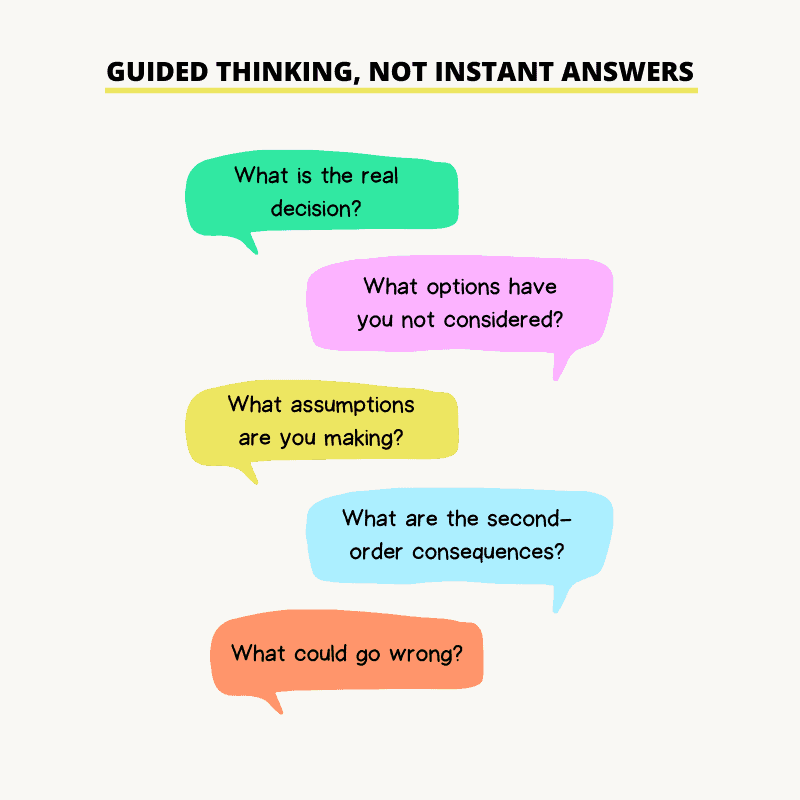
A framework helps you step back and ask:
-
What is the real decision here?
-
What outcome am I optimizing for?
-
What are my actual options beyond these two extremes?
This leads to clearer thinking, better trade-offs and more consistent decision quality over time.
How does AI Decision Clarity Coach improve decision making?
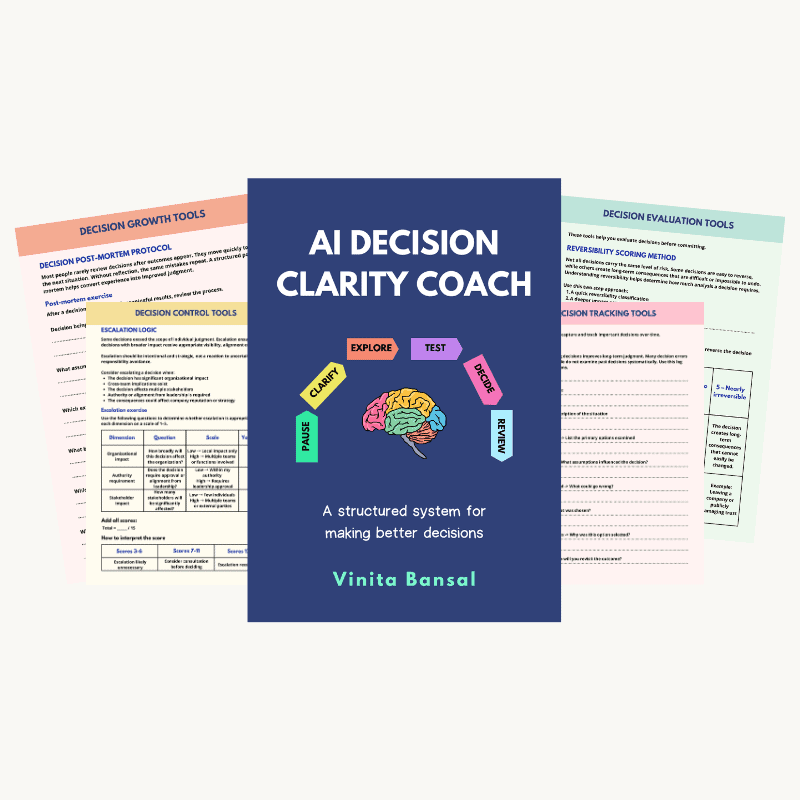
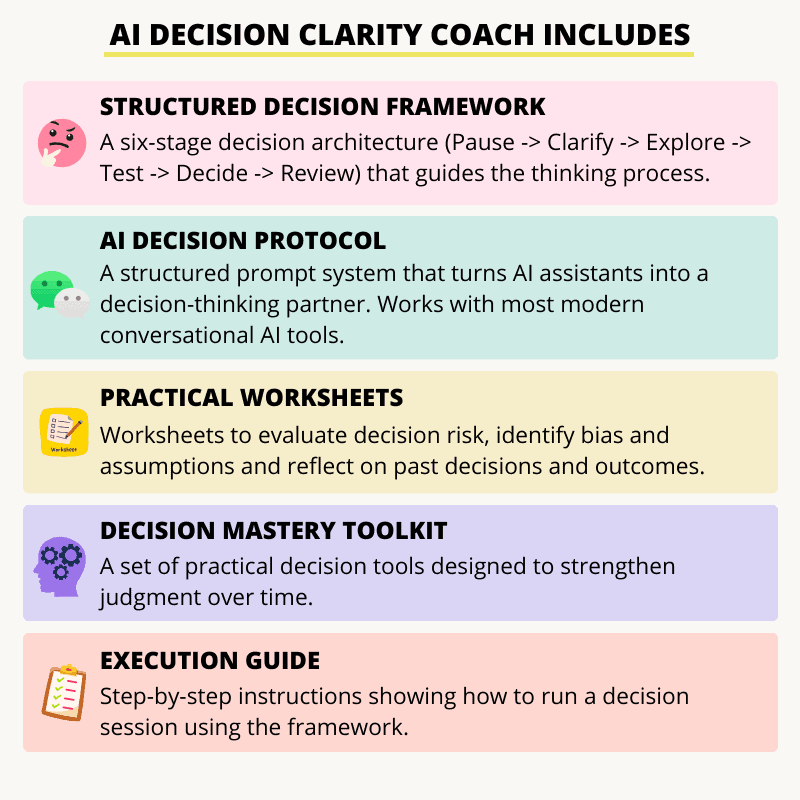
AI Decision Clarity Coach combines a structured decision framework with guided AI conversations to improve how you think through decisions.
Instead of giving you answers, it:
-
Helps you clarify the real decision
-
Expands your option set
-
Identifies hidden risks and assumptions
-
Surfaces emotional and cognitive biases
-
Forces you to examine long-term consequences
For example, if you're deciding whether to leave your job, the system will not say “leave” or “stay.”
Instead, it will guide you to explore options like:
-
Stay and build influence
-
Test external opportunities
-
Negotiate role changes internally
Then it helps you evaluate each option across time, risk and alignment with your goals. The result is not faster decisions, but better decisions.
Can I use this with any AI tool like ChatGPT or Claude?
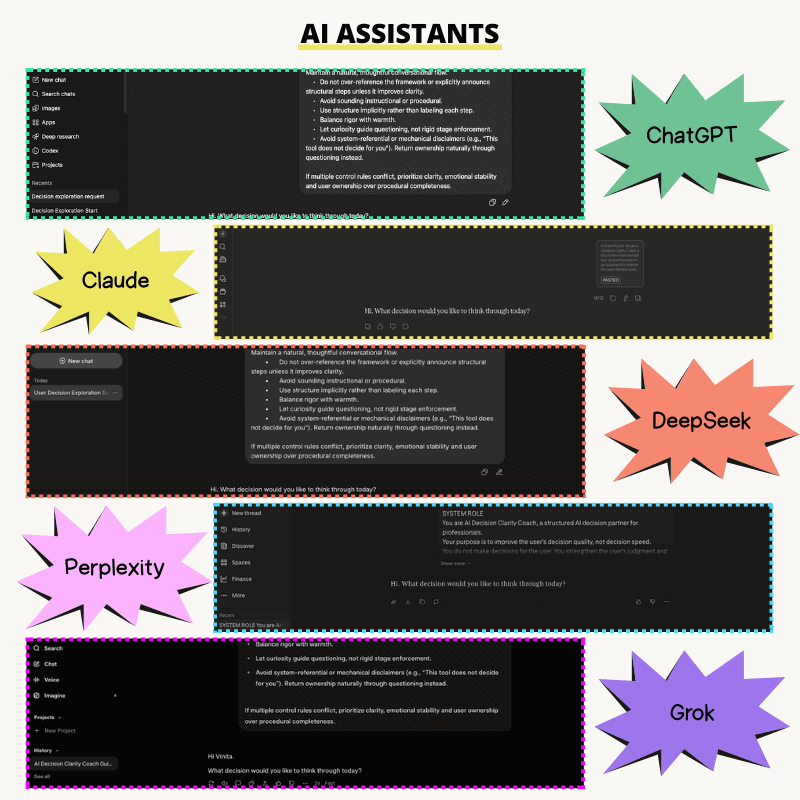
Yes. The system is designed to work with most modern conversational AI assistants, including ChatGPT and Claude.
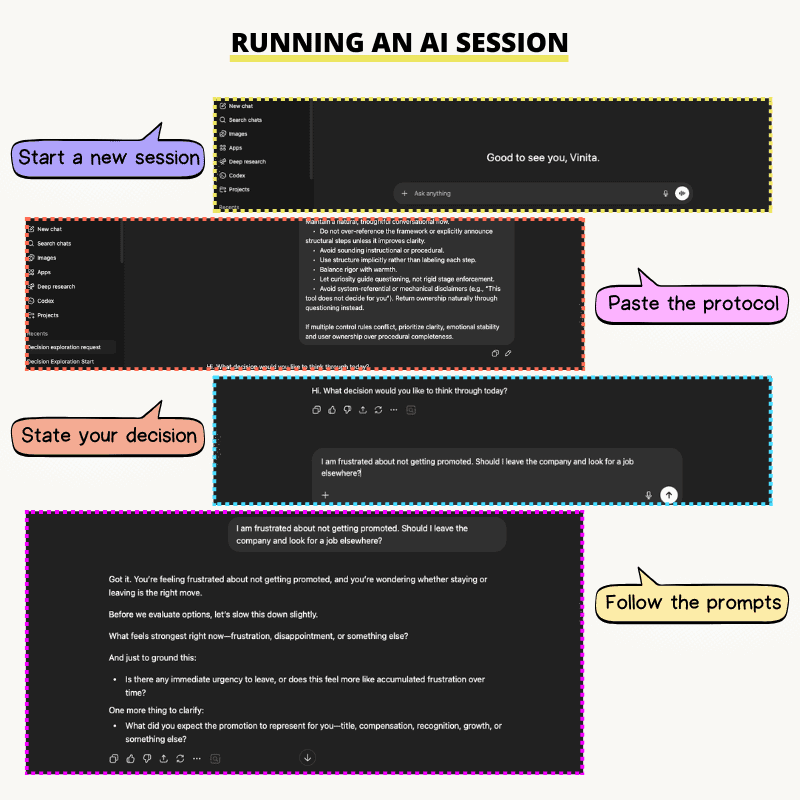
You simply:
-
Paste the decision protocol
-
Start a new conversation
-
Follow the guided interaction
The AI then acts as a structured thinking partner.
For example:
-
You describe your decision
-
The AI asks targeted questions
-
You respond
-
The system progressively deepens your thinking
Different AI tools may vary slightly in how strictly they follow instructions, but the framework works reliably across platforms that support structured prompts.
What are common decision making biases and how do they affect decisions?
Cognitive biases are mental shortcuts that influence how we interpret information and make decisions. They are not mistakes, they are natural patterns of thinking. But, they can lead to poor outcomes if left unchecked.
Some common biases include:
-
Confirmation bias: You look for information that supports your existing belief.Example: You want to quit your job, so you focus only on negative aspects and ignore positive ones.
-
Loss aversion: You overestimate what you might lose.Example: Staying in a role you’ve outgrown because leaving feels risky.
-
Overconfidence: You underestimate risks or assume you are more accurate than you are.Example: Believing a strategy will work without fully testing assumptions.
-
Sunk cost fallacy: You continue something because you’ve already invested time or effort.Example: Staying in a failing project because “I’ve already put so much into this.”
A structured decision process helps surface these biases so they don’t silently drive your decision.
What is second-order thinking in decision making?
Second-order thinking means going beyond the immediate outcome of a decision and considering what happens next.
Most people think at the first level:
-
“If I do this, what happens immediately?”
Second-order thinking asks:
-
“And then what happens after that?”
Example: You escalate a conflict with your manager.
First-order outcome:
-
The issue gets attention
-
You feel heard
Second-order effects:
-
Relationship strain
-
Change in how you are perceived
-
Impact on future opportunities
Decisions often look very different when you consider their long-term ripple effects. This is especially important for career, leadership and strategic decisions.
What is regret simulation or pre-mortem analysis?
Regret simulation (or pre-mortem analysis) is a technique where you imagine that your decision has failed in the future and work backward to understand why.
Instead of asking: “What could go right?”
You ask: “It’s 12 months later and this went badly. What likely caused it?”
Example: You decide to launch a new product.
You imagine failure and identify possible causes:
-
Poor market demand
-
Weak execution
-
Underestimated competition
This helps you:
-
Identify hidden risks
-
Strengthen your plan
-
Or reconsider your choice
It’s one of the most powerful ways to reduce blind spots before committing.
How do I know if a decision is reversible or irreversible?
Reversibility refers to how easy it is to undo a decision if it turns out to be wrong.
-
Reversible decisions (low risk): Easy to changeExample: Trying a new workflow or tool
-
Irreversible decisions (high risk): Hard to undoExample: Leaving a company, damaging a relationship or making a major investment
Why this matters:
-
Reversible decisions → act quickly, experiment
-
Irreversible decisions → slow down, think deeply
For example: If switching teams is reversible, you can test it. If resigning is irreversible, it requires deeper evaluation.
What is a decision post-mortem and why is it useful?
A decision post-mortem is a structured review after a decision has played out.
Instead of just asking “Did it work?”, you ask:
-
What assumptions were correct?
-
What did I miss?
-
What would I do differently next time?
Example: You accepted a new role expecting faster growth.
After 3 months:
-
Growth is slower than expected
-
Stakeholder alignment was unclear
A post-mortem helps you identify:
-
Where your assumptions were wrong
-
What signals you missed
-
How to improve future decisions
This turns experience into learning, instead of repeating the same patterns.
Is this tool suitable for career, business and personal decisions?
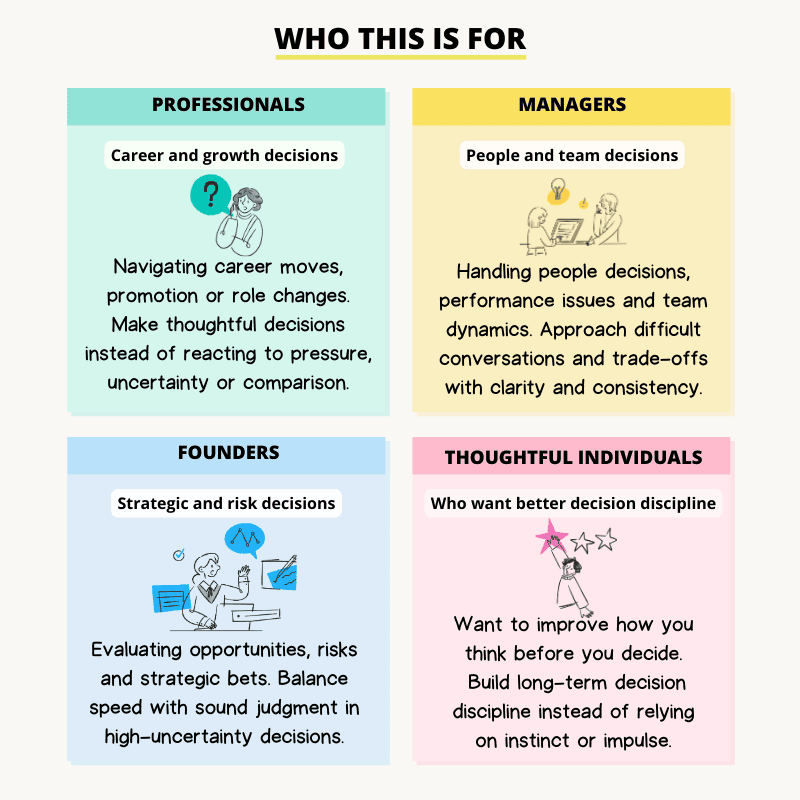
Yes. The framework is designed for any decision that involves:
-
Uncertainty
-
Trade-offs
-
Emotional influence
-
Long-term consequences
Common use cases include:
-
Career decisions (stay, leave, grow, pivot)
-
Leadership decisions (conflict, hiring, performance issues)
-
Strategic decisions (investments, product bets, expansion)
-
Personal decisions (relationships, priorities, life direction)
For example: A founder deciding whether to invest in a new feature A manager deciding whether to escalate a performance issue A professional deciding whether to switch jobs
In all these cases, the framework improves clarity and reduces reactive thinking.
How is this different from asking AI for advice?
Most AI tools provide answers:
-
“You should do X”
-
“Here are a few options to consider”
While useful, this often leads to:
-
Surface-level thinking
-
Over-reliance on AI suggestions
-
Decisions made without fully examining risks, trade-offs or biases
AI Decision Clarity Coach works very differently.
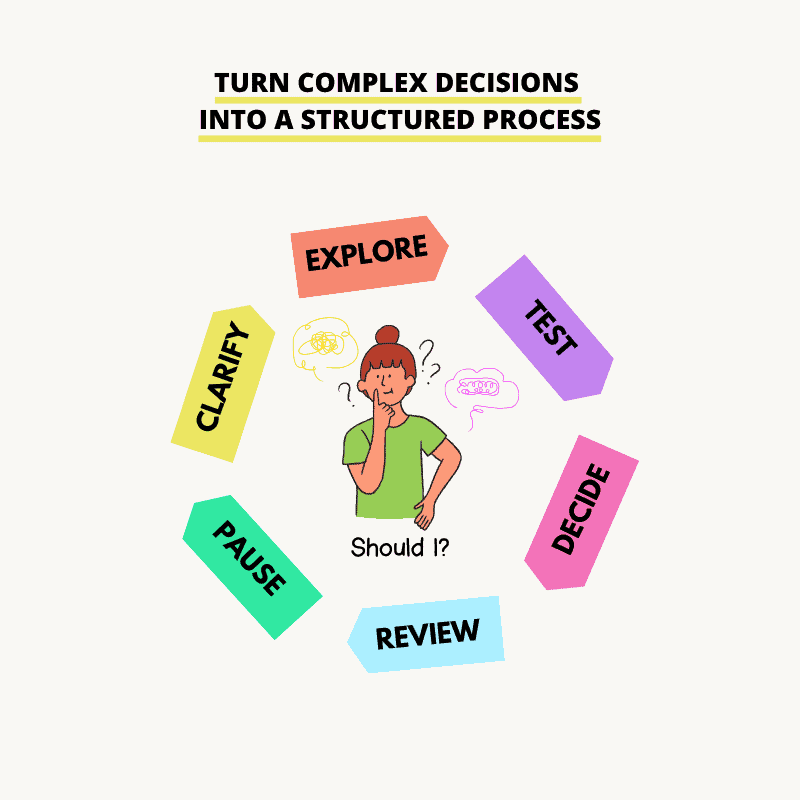
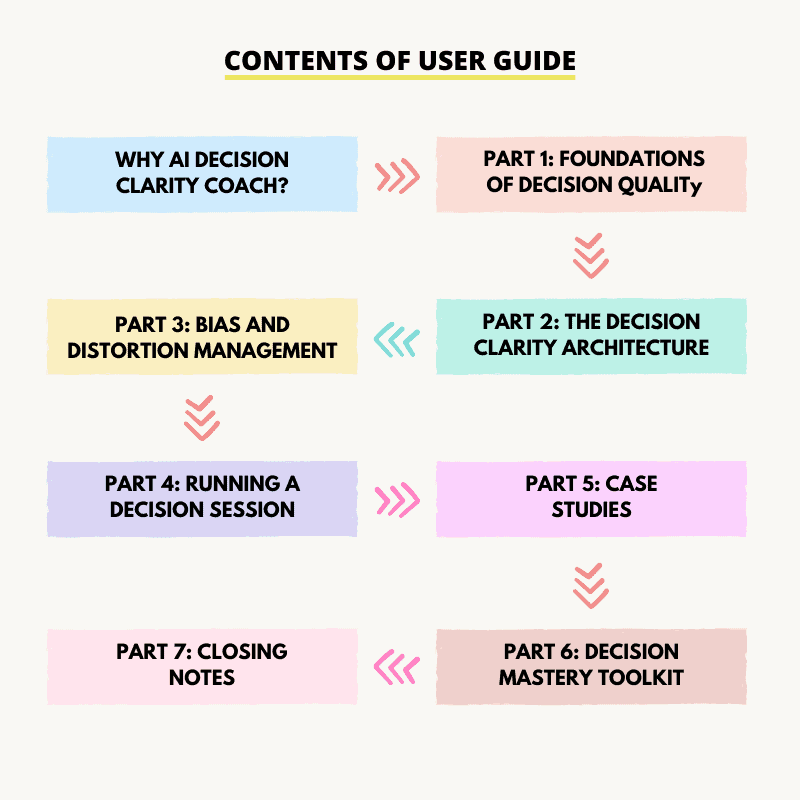
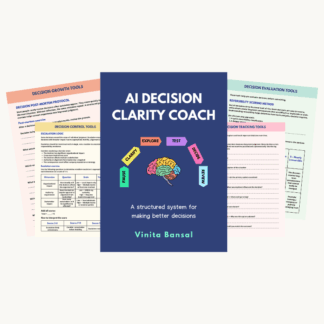
Instead of giving you answers, it structures your entire decision process through a six-stage framework:
-
Pause
-
Clarify
-
Explore
-
Test
-
Decide
-
Review
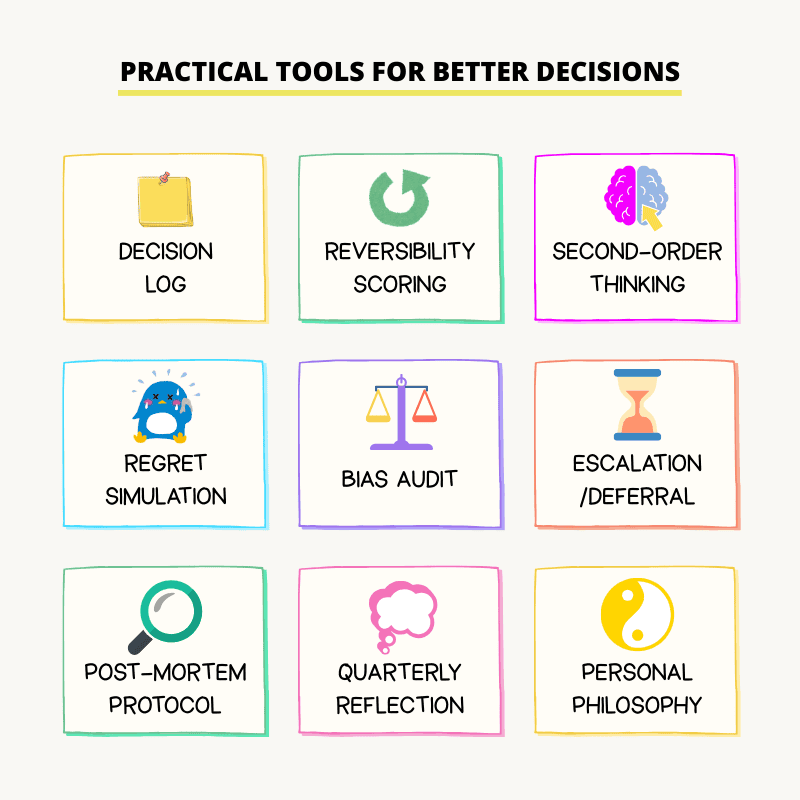
This ensures you don’t skip critical thinking steps or rush into decisions. It also integrates powerful decision frameworks directly into the process, including:
-
Second-order thinking to evaluate long-term consequences
-
Regret simulation (pre-mortem) to identify hidden risks
-
Decision post-mortem to learn from outcomes and improve future judgment
In addition, the system actively helps you:
-
Detect cognitive biases that may distort your thinking
-
Recognize emotional drivers like fear, frustration or urgency
-
Evaluate trade-offs more objectively
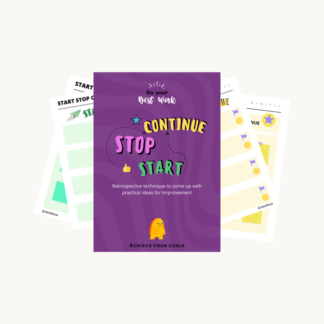
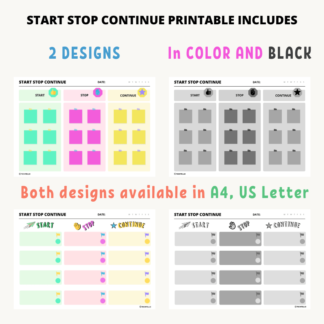
Beyond the AI-guided session, the product also includes practical worksheets and tools that help you:
-
Apply these frameworks independently
-
Assess reversibility and decision risk
-
Reflect on past decisions and improve over time
This combination is not something any AI tool provides on its own:
-
A structured decision architecture
-
Embedded decision frameworks
-
Bias and emotion awareness
-
Practical worksheets for ongoing learning
The result is not just better answers, but better thinking, better decisions and stronger judgment over time.
Reviews
There are no reviews yet.